This is part of the How to Big Wall Climb SuperTopo book. Videos like the ones above illustrate key points of the book and are meant to be watched while reading the book. Buy the book here or just read this free sample of the text below with photos.
Visit on supertopo.com
 |
 |
|
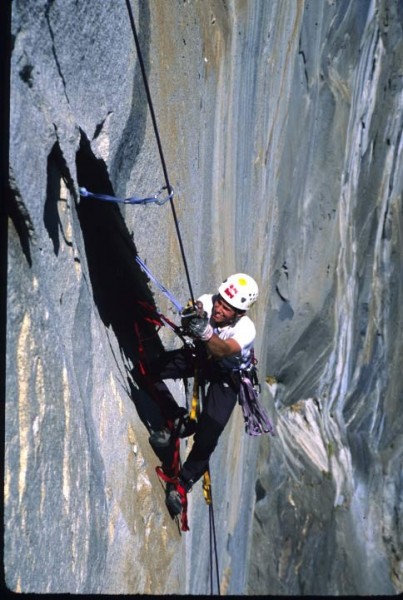 Chris McNamara jugging high on Zenyatta Mondatta, El Capitan. Long slings protect the rope from the sharp edge. Credit: Jason "Singer" Smith |
||
 |
 |
Anchor a free-hanging rope 20 to 30 feet up. Have the rope length be at least 200 feet.
Following: The Basics
The difference between efficient and inefficient Ascender technique or “jugging” is subtle but crucial. The wrong technique burns your arms and causes bad bicep and forearm cramps. On my first one-day ascent of The Nose I used such bad technique that my arms started locking up around the Great Roof with terrible cramps. I wasn’t sure I would be able to finish the route. NOTE: For the rest of this book I use the term “jug” or “jugging” to describe ascending a fixed rope with mechanical Ascenders.
Skills to learn
 Smoothly take the Ascender on and off the rope. Keep you weight on your feet—not on your arms. “Walk up” the rope.
Gear You Need
2 Ascenders 2 daisy chains 2 Aiders 3 locking biners helmet rope gear for anchor belay device Optional gear: gloves, fixed-rope self belay deviceWhere to Practice
The same place you used for basic leading in the previous is probably best place to learn to jug. I learned to jug on a free hanging rope hung from a tree. Don’t do that! Like leading, the best place to learn to jug is on a 30 to 50-foot, 80-degree smooth wall. Eighty degrees is not only a common angle you find on big walls, it is also much much easier to learn on. If you start on overhanging terrain you will get more frustrated and develop more bad habits. If the 80-degree wall at your climbing gym has too many giant holds they will get in the way.
Tip: before you start, it’s a good idea to practice two techniques:
1- The motion of opening and closing the cam of the Ascender. Spend 10 or 15 minutes opening and closing the cam with your right and left hands. Then hang a piece of climbing rope in front of you and practice taking it on and off the rope for 10 to 15 minutes.
2 - Practice retracting the Ascender cams with your thumb to slide the Ascender up and down the rope without actually taking it off the rope.
Basic Ascender Setup
1. Attach the daisy chains to your harness.
2. Connect Aiders to locking biners.
3. Attach Ascenders to rope. If you are right-handed, the right Ascender goes on top.
4. Clip a daisy chain and Aider to the bottom Ascender (if you want extra peace of mind, use a locking biner. I don’t but I probably should.)
5. Clip a biner attached to a daisy chain and Aider to the top Ascender.
6. Figure out the right length of daisy chain for the top Ascender and clip the daisy chain directly into the locking biner and lock the gate.
Key point: Get the top daisy length right. If the daisy connected to the top Ascender is too long, you will put too much weight on your arms. If too short, you will make ascending motions that are too short and inefficient. The way to know that you have the right length is when you hang with all your weight on the daisy chain, your arm comfortably holds the Ascender with a small bend. (TK Show three photos: good, daisy too short, daisy too long)
If you just have one daisy chain, use it to attach yourself to the top Ascender. Use two intertwined shoulder-length runners to connect to the bottom Ascender.
If you don’t have any daisy chains, use one shoulder-length runner to attach yourself to the top Ascender. Use two intertwined shoulder-length runners to connect to the bottom Ascender.
Video: Ascender Set Up
Two Ascending Techniques, One Principle
The two ascending techniques depend on whether a) The wall is vertical or overhanging, or b) The wall is less than vertical. In either case, the most important thing is to keep as much weight as possible on your legs and as little weight on your arms. In this chapter we cover less than vertical terrain. In the next ascending chapter we cover vertical and overhanging terrain.
A. Less Than Vertical Wall (slabby wall)
1. With your feet out of the Aiders, pull the slack out of the rope by alternately sliding the Ascenders up the rope.
2. If you are right-handed (right Ascender on top) you put your left foot in the third step of an aid ladder or the second step of a standard Aider. Push the right Ascender as high as you can, then put your right foot in the fourth step of an aid ladder or the third step of a standard Aider. Note 1: If you are left-handed, reverse this. Note 2: If you are taller than six feet, you might need to put your feet lower.
3. Once you have pushed the top Ascender as high as it will go, shift your weight onto the Aider connect to the top Ascender. Ease your weight off the Aider connected to the bottom Ascender and slide up the Ascender.
4. Repeat. At first it is tricky to coordinate the weight shifting. But in a short time it will start to flow.
Key Tip
The most important point: Unlike overhanging jumaring where you have to use both your arms and legs, on less-than-vertical jumaring you should have all your weight on your legs. Your arms are only there to move the Ascenders up—never to rest on. The best way to do this is lean into the rock as much as possible. On just under vertical terrain, you will need to nearly touch your nose to the rope in order to keep your weight totally on your feet and not on your arms.Two common frustrations when learning
When leaving the ground or a belay, if there is not much rope below you, the bottom Ascender won’t slide up on its own. You have to manually open the cam a little with your hand. At first this is annoying and awkward and you will be tempted to take you hand off the top Ascender and use it to tension the rope below the bottom Ascender. This works but is inefficient. It is better to get good at manipulating the cam with your hand so that it slides up and down. See the tip at the beginning of the chapter. At first your feet will come out of the Aiders. This is normal. Over time you will get better at maintaining the right pressure between you feet and the Aiders so that they stay in. I never use elastic or anything else to keep my feet in the Aiders because it ends up taking more time than it saves. And often you want to be able to get your feet out of the Aiders fast.Read the rest of this chapter in the How to Big Wall Climb SuperTopo book
Visit on supertopo.com