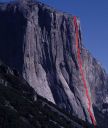
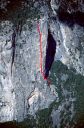
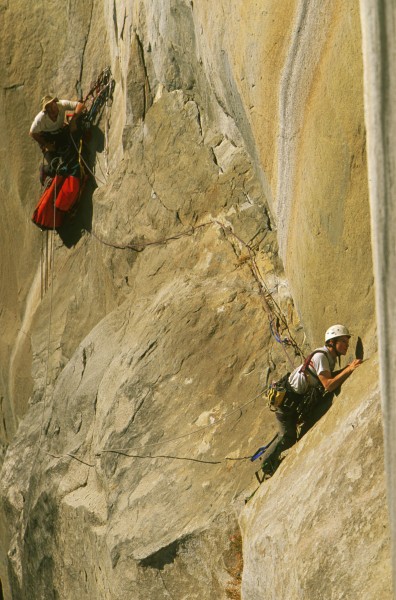
Chris McNamara leading Pitch 3 of Tangerine Trip, El Capitan.
Credit: Corey Rich
Basic Leading Technique
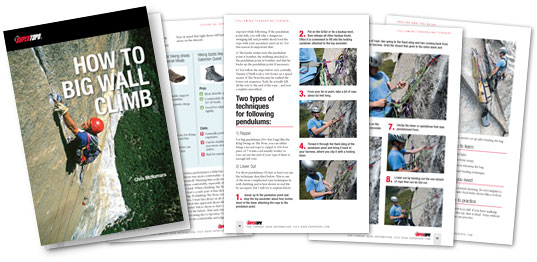
This is the most important part of the book. Most big wall climbers fail because they learned the aid climbing basics but never took the time to master them. There’s a huge difference between knowing what to do and being able to do it fast.
Having the basics dialed means moving up your Aiders almost as fast as walking up a stepladder and then making a smooth and quick transition to the next piece with minimum time spent organizing gear. This translates to climbing a C1 or C2 in less than an hour. It means getting to the bivy with hours left in which to enjoy the end of the day instead of setting up the portalege by Headlamp. It means finishing with extra water on the summit, not rationing water and climbing light-headed on the last day.
The good news for folks who don’t live near Yosemite is that 80 percent of success comes from mastering aid climbing basics that you can do just about anywere—at your local cliff, in a gym, or in your backyard tree. You don’t need to be in Yosemite until you get to the multipitch training.
Skills to Learn: Efficiently moving from piece to piece Keeping the Aiders untangled Always knowing where the Aider is Using the most simple system possible Walking as high in the Aider as efficiently possible
Where to Practice
The best wall to learn on is on a wall that is 30 to 50 feet tall and just less than vertical. Important: Don’t start on an overhanging wall or you will be frustrated and start developing bad habits. Some good places to start:
• A bolt ladder in a climbing gym (important that it is less than vertical).
• A sport climb with bolts close enough to reach (you only need four to six bolts).
• Any short crack route that takes gear every four feet.
Solo fixed rope self-belay or partner?
It is always nice to have a belayer and partner. However, on your first aid lead you will discover a fundamental law of aid climbing: you are always moving slower than you think, much slower. You feel that you are moving at a moderate pace but your belayer and the clock tell you otherwise. Trying to find a partner to aid climb with is like finding a friend to go to traffic school with. It is possible to practice almost every aid technique with a fixed rope self-belay by anchoring (or “fixing”) a single rope to the top of the cliff and then using a device like the Petzl MiniTraxion to self-belay.
The ideal setup is to find a buddy to do this course with you. You then find a cliff that has two climbs side by side. That way 30 percent of the time you can belay, encourage and help each other person while 70 percent of the time you can self-belay on a fixed rope. This way you each get in a lot of laps.
Warning: there is a big difference between a solo fixed rope self-belay (described above) and solo lead self-belay. On a properly set up fixed rope self-belay, you don’t “fall” because you are essentially on top rope. Solo lead climbing is a whole different thing. It is much more advanced and dangerous than a fixed rope self-belay. It is more dangerous than lead climbing with a partner because there are so many more things to go wrong. It is an advanced technique not covered in this book (but maybe in a future one).
Essential Gear you Need to Start 2 Aiders (ladder Aiders are best to learn on) 3 locking biners helmet rope gear for anchor belay device Fifi-Hook 4-6 carabiners quickdraws (1 per bolt or placement) stopwatch
The Basic Aid Climbing Sequence
The Basic Aid Climbing Sequence
There are four ways to set this up. On top rope On top rope trailing a second line as a “mock lead rope” Solo fixed rope self-belay Leading
Do whatever is most conducive to getting in a lot of laps.
2. Clip your Aider directly to a piece. Never clip the biner attached to the piece because this shortens your reach to the next piece. If using etrier-style Aiders, make sure the Aider is oriented correctly (if stepping with your left foot, the step is left of center).
3. Without stopping, walk up all the way until your waist is at the piece (or higher if you can).
Tip It's more comfortable to put yours heels together and smear the foot that is not in the Aiders on the wall.
4. Take your other Aider and clip the next piece. Make sure the Aiders are not overlapping and the steps are not twisted.
5. Step into the next Aider at the highest step that is comfortable (usually this is a step or two up from the bottom).
6. Unclip your bottom Aider and clip to the side of you harness. Always clip the Aider to the same spot so it forms a habit and you always know where to go for it.
7. Clip the rope to the piece (skip this step if you are top roping without a mock lead rope).
8. Walk up the Aider all the way until your waist is at the biner. If you can balance, then go even higher in the Aider. In general, you want to walk as high as efficiently possible.
About the Author Climbing Magazine once computed that three percent of Chris McNamara’s life on Earth has been spent on the face of El Capitan—an accomplishment that has left friends and family pondering Chris’s sanity. He has climbed El Capitan more than 70 times and holds nine big wall speed climbing records. In 1998 Chris did the first Girdle Traverse of El Capitan, an epic 75-pitch route that begs the question, “Why?”
Outside Magazine called Chris one of “the world’s finest aid climbers.” He is the winner of the 1999 Bates Award from the American Alpine Club and founder of the American Safe Climbing Association, a nonprofit group that has replaced more than 5000 dangerous anchor bolts. He is a graduate of UC Berkeley and serves on the board of the ASCA and the Rowell Legacy Committee. He has a rarely updated adventure journal, maintains BASEjumpingmovies.com, and also runs a Lake Tahoe home rental business.
You definitely seem to want to push the 2 aider system!
The videos were a bit big, but thats OK. I would also recommend filming the video silent and doing a voiceover. Its easier in instructional to narrate because you can control the volume, i.e. you aren't facing away from the camera, facing towards, stopping to take a breath because you just climbed up some aiders, etc etc.
That is what I would call a chosspile! Reminds me of my local spots.
I love that you mentioned that Tom Frost climbed 4 el cap routes in the 90's. I didnt know that! Holy crud! Also, mentioning that climbers did more with less brings up an important ideal, and reaffirms climbers that, although it can seem that way, its not about the gear!
Werner: "On hard A5 who spends only a minute on each placement?"
But maybe this is a key to the kingdom of efficient climbing.
I am slow, I am scared, the climbing looks hard, perhaps the
climbing is genuinely hard. But it does not help to spend more
time lounging in my aiders. Once the proper bounce test is done,
I gain nothing by lounging around.
Now the reality: I am slow, I am scared, the move looks hard,
the pitch looks long. I climb up one step, fiddle around (usually
I have plenty of unnecessary cluster to fiddle around with -
extra aiders being one of them), then think about the next piece
and eyeball the potential placement. Think a little bit about
what the next piece should be, and where it should be. Should
it be this nice bomber placement nearby or should it be this
less bomber thing that I can't see clearly, slightly higher.
Okay, maybe I need to take another step and "check out the
placement". But first, I need to sh*t my pants a bit. Finally
I decide to take a step up. Shorten the daisy "to get a bit
comfortable" before taking the step. Then engage in a three
step process to take one step: (1) step up with one leg in one
of the aiders, (2) immediately shorten the daisy and hang from
it (3) step up with the other leg in the other aider. Futz
around with the daisy chain. Check my pants to see if they are
soiled. ... etc.
I'm thinking that Chris' advice here is really cutting to the
heart of the matter. He is ostensibly teaching the mechanics of
climbing efficiently, but at the core of it he is probably
trying to teach a MENTAL game: somehow catharsizing the fear
into action (rather than sloth), somehow transcending the
mental barriers. And Chris is very well qualified to give this
kind of instruction; when a master of the craft talks, I will
certainly pay attention.
Chris,
This is awesome stuff. You are really advancing aid climbing
instruction in ways that nobody else has done. Nobody spills
the "secrets" so well. I have 3 books on aid/wall climbing,
and none of these get to the heart of the matter like this.
The videos are fantastic, and will propel your book (or
whatever combination of book/video the final product becomes)
to the top of the list.
So if writing this book seems hard, I want to provide moral
support and encouragement. It is always hard to do something
that is leaps and bounds better than anything else around,
and to really make a big jump forward. This book will be a
MAJOR ADVANCEMENT for its intended climbing audience, the
preview material is simply fantastic.
"2. Clip aider directly to piece. Never clip the biner attached to the piece because this shortens your reach to the next piece)."
I wouldn't say this necessary shortens the reach because the reach depend more on which step you use. What am trying to say, it is possibly to use a biner and get equally high if the steps on the aider is 2-3 inches higher up. Did I make any sense?
The reach also depends more on where you connect your fifi or biner compared to where you connect the ladder.
It makes a difference in top stepping though but the distance of an extra biner is still much less than the distance between the steps.
"7. Unclip your bottom aider and clip to the side of you harness.
8. Clip a quick draw to the bolt and clip the rope in."
The problem here is that you have a short time when you are not connected to the lower piece at all. Maybe not a big deal but could result in a long fall if you are unlucky.
Do you really lose something if you first connect a biner to the piece, attach the ladder to the biner and connect the rope earlier (when it is natural to do it)?
This will be a superb book! Thanks for your efforts.
I especially encourage you to keep it up with the videos.
Reading about a technique, then seeing a short video clip of it, can be a very beneficial learning method. Some learn better from reading, some from watching.
Maybe make the vid section it's own website, with a few free ones as teasers, then offer a cheap subscription where you could see them all if you paid a little.
I'd love to see a video clip of you climbing a bolt ladder as fast as possible. I understand your ideas on doing it, and it'd be exciting to see you really smoking up some bolts.
Aid climbing can be such a pain, and I am glad that I have not had to do much, but that said, I do aspire to do more big walls to add to the meagre (overstatement or understatement?) I have done, so stuff like this is helpful.
I just wish I was good enough of free climber to dispense with the aid on most routes on my tick list.
"Should it be this nice bomber placement nearby or should it be this less bomber thing that I can't see clearly, slightly higher."
statement in regard to Werner's A5 comment.
I have never done A5. But I have done A3 fine litttle line called Mescalito. Bomber is not the word that comes to mind on the hard parts. And i remember one part high up on the headwall where the last piece i had clipped to my rope was a 1/4 inch buttonhead that Porter himself had likely placed about 40 feet below. I hadn't clipped any of the intermediary pieces because they were either hooks or bad rivets that simply would not have held a fall and I didn't want to rip the line. For one, I certainly was spending far longer than a minute on each piece and for two, i wouldn't have bounce tested those pieces to save my life. Maybe I don't know much about aid, but my approach was as gentle and smooth and slow as a sloth. Call me timid, but in big head space, with room for big air, I am not a fan of the aggressive bounce test and quick movements.
But if Andrew Barnes or anyone else wants to tell me I should try the aggressive bounce test on the last three intact wires of a an old blown out rurp when I'm looking at a big fall and the wind is rippin on the upper part of the captain, then I respectfully admit that you are a bigger man than me.
Nice work Chris. You've really hit the pin on the head...so to speak. Can't say that I totally agree with you on the 2 aider thing...but then again on well-traveled routes with lots of straghtforward placements I totally agree that it's faster. Proly your best advice is the bounce testing sequence. Critical. If you don't know that a peice can hold a jolt then you're tread'n on thin ice...blind! I've only had one pitch ever that I stopped bounce testing on... "don't skate mate" and hence the name. Saw a 1/2 skid mark from a high-stepped, blindly placed hook about to rip over the edge, so I desperately found the next best placement possible. Unfortunately it was also a top-stepped blind hook and it did the same thing. This went on for about 1/2 the pitch and I vowed to never get in that situation without testing. You've got to know where you're at with each placement.
Besides, it's totally Biblical..."Test all things, and hold fast to what is good!" (1st Thess 5:21)
Good luck with the book, hopefully it will inspire and save some behinds in the process!
"But if Andrew Barnes or anyone else wants to tell me I should try the aggressive bounce test on the last three intact wires of a an old blown out rurp when I'm looking at a big fall and the wind is rippin on the upper part of the captain, then I respectfully admit that you are a bigger man than me."
Chris has an 'exceptions' clause in the draft if you read close enough. I'm sure it will be more apparent in the final draft that he isn't advocating the aggro bounce in the above situation.
CMac, keep up the good work! I really enjoyed the first drafts of text / vids, (though they're still in need of some editing.) As a lowly free climber with no aid experience, I find your practical explanations and advice _exactly_ what I need. It's like I'm actually climbing with someone who knows what they're talking about, rather than reading the same crusty basics in different texts. Honestly, I've read the 'basic aid sequence' in several different texts, but they all say the same thing and result in me simply saying to myself, "sh#t...that's easy." without really going into specifics that one needs when they actually go out and practice (and subsequently realize how involved it actually is).
When you are setting the piece on the outdoor video you do a bounce test on that, is your left foot in this case still in the other aider with enough weight on it? Also is there a reason why you would not want to clip a draw to the piece below and your rope before bounce testing the piece above? I could maybe see where the really hard bounce test might fail in which you would then fall a lot father, or is this suppose to be caught by keeping enough weight on the left foot.
Yikes, Chris - you can't send guys out practice aid climbing with nothing more than a Mini-Trax on a toprope!
Yes, you can use a Mini-Trax, but you should use two as has been described somewhere on the McForum. And you need to mention how important it is to weight the bottom of the rope so you are knott shock-loading your belay rope with a toothed cam!
I think a Grigri would be much better, since you're always moving more slowly aiding than free climbing and it's not that hard to pull the slack through. And you are apparently forgetting the fundamental principle - ALWAYS tie a backup knot!
[Maybe I missed the above, I skimmed through fairly quickly]
Those are great tips for NBD aid that will work into the NTB range. But as Werner points out, it's a whole different ballgame in the PDH - DFU zone.
The climbing is an exciting and challenging activity. At weekend, I go climbing with my friends, to release the pressure usually work. if you like Photography, convert avi to itunes is useful for you. here
great video! i recently purchased your how to big wall climb book and it is awesome. i went out today to use my new aiders for the first time ever and was able to do two laps on the 80' bolt ladder in stoney point in SoCal.
first lap was hard as hell. took me 25 minutes and my arms were spent. second lap, i charged through it and did it in 12 minutes. kept thinking about your efficiency advice and just climb as high as you can.
the bolt ladder was 85-90 in parts and i did have trouble getting my foot in the aider a few times when it was weighted and basically pressed into the wall. i used my toe to step up and that hurt. any advice on how to get my foot in it in that scenario?
I tried the no daisy technique on the 2-3rd pitch of the Prow and was exhausted by the time I reached the belay. I will defenetliy be investing in a pair of Yates adjustable daisies in the near future. On low angle less than vert using no daisies was pretty easy but as soon as it got steep it became quite the workout.
I climbed the whole Shield and never used a daisy. You need to learn to "free climb" in your aiders and learn the rest step.
Cheyne Lempe uses only two ladders, permanently attached to two Metolius Daisies and he's easily as fast as anyone one this site (can you say three one day solos of El Cap). I use two sets of two aiders and I'd say that I'm a faster aid climber than most. It's all what you get used to.
I can't even imagine commenting on this thread in likes of those who have posted, but I will. Using two ladders as opposed to 2 sets of ladders is much less of a cluster, but man in the awkard leaning corners having 2 sets of 2 are NICE!!! As far as daisies, I went with Metolius adjustable and having just done my first wall, Lurking Fear and only leading 5.10 I rarely if ever adjusted them and could easily see climbing my next wall without them. I did however think of using a yellow daisy for my left and blue for my right to keep the cluster down. That's all this newbie has for now.
Being that it was my first attempt at any sort of aid climbing I was pretty happy with my performance and really excited to do more. One thing that was really frustrating was the constant untwisting and botched steps in my off set aiders. After using ladder style aiders and just being able to walk up the aider and not have to think about getting my foot on the right step or left made it really easy. I will for sure stick to just two aiders, at least in the near future but will probably switch to ladder style.
I was able to use my cam hooks and hand placed a few tomahawks on the second pitch of the Prow making progress relatively easy and fun.
After 35 years of climbing I am finally realizing my dream of wall climbing and it has been a blast just learning the basics.
Bottom line is I just need to get out and do more, that should be no problem since I live in Burbank which is pretty much big wall central.





 Efficiently moving from piece to piece